Grigori Fursin, PhD
Understanding Complex Systems. Building Them to Adapt to a Changing World.
Vice President, Head of Dapple Labs — Research & Systems Strategy at Dapple | Interdisciplinary AI systems scientist and hands-on systems architect | Research on adaptive, self-optimizing, and resource-efficient computing; full-stack software–hardware co-design; reproducible R&D; knowledge engineering; and compute economics
What I do and why
I began with a childhood question about intelligence: how does the brain work, and how can we build intelligent machines that do useful things in the real world? Over more than three decades, that question became a practical mission: to understand—and improve—the physics, engineering, and economics of intelligent computing so that complex systems can remain efficient, useful, and adaptive as workloads, technologies, and requirements change.
I am an interdisciplinary scientist, systems architect, R&D leader, entrepreneur, and educator. I work across algorithms, models, software, hardware, data, infrastructure, and real-world constraints. This breadth is not a collection of unrelated interests: it came from repeatedly following the real bottlenecks. I combine first-principles reasoning, hands-on engineering, empirical measurement, machine learning, and reproducible experimentation to understand entire systems and turn research ideas into practical technologies, products, teams, communities, and businesses.
Current work and longer-term direction
I am currently Vice President, Head of Dapple Labs. I lead research and systems strategy at Dapple, connecting production AI workloads with computing infrastructure. Dapple is building the Enterprise OS Cloud for organizations that need dedicated, reliable, and controlled AI infrastructure. My work focuses on reproducible evidence, continuous benchmarking and learning, workload–system matching, performance and cost modelling, and full-stack software–hardware–infrastructure co-design. The aim is to help computing systems and the decisions around them improve continuously as workloads, software, hardware, data centers, constraints, and economics change.
My broader research agenda remains deliberately long-term: adaptive and self-optimizing computing; practical, resource- and cost-efficient AI; continuous benchmarking and technology evaluation; reproducible and increasingly autonomous R&D; cost-aware agentic automation; digital twins and simulators; and knowledge engineering that helps systems and teams learn from every experiment and continuously improve. Across this work, I balance performance, scalability, robustness, scientific productivity, cost, energy use, complexity, and time-to-production rather than optimizing one metric in isolation.
I also founded cTuning Labs and the cTuning Foundation, where I remain Chief Scientist. Their long-term aim is to help researchers and organizations evaluate, validate, integrate, and improve emerging deep technologies through open tools, education, reproducible methods, and shared knowledge. The cTuning.ai platform continues my Collective Knowledge, Collective Mind, and MLPerf automation work on top of the open-source Common Meta Framework (cMeta/cX), providing common interfaces to connect and reuse code, data, models, agents, workflows, experiments, and knowledge. Independent platform development is currently paused while I concentrate on Dapple.
One path through successive bottlenecks
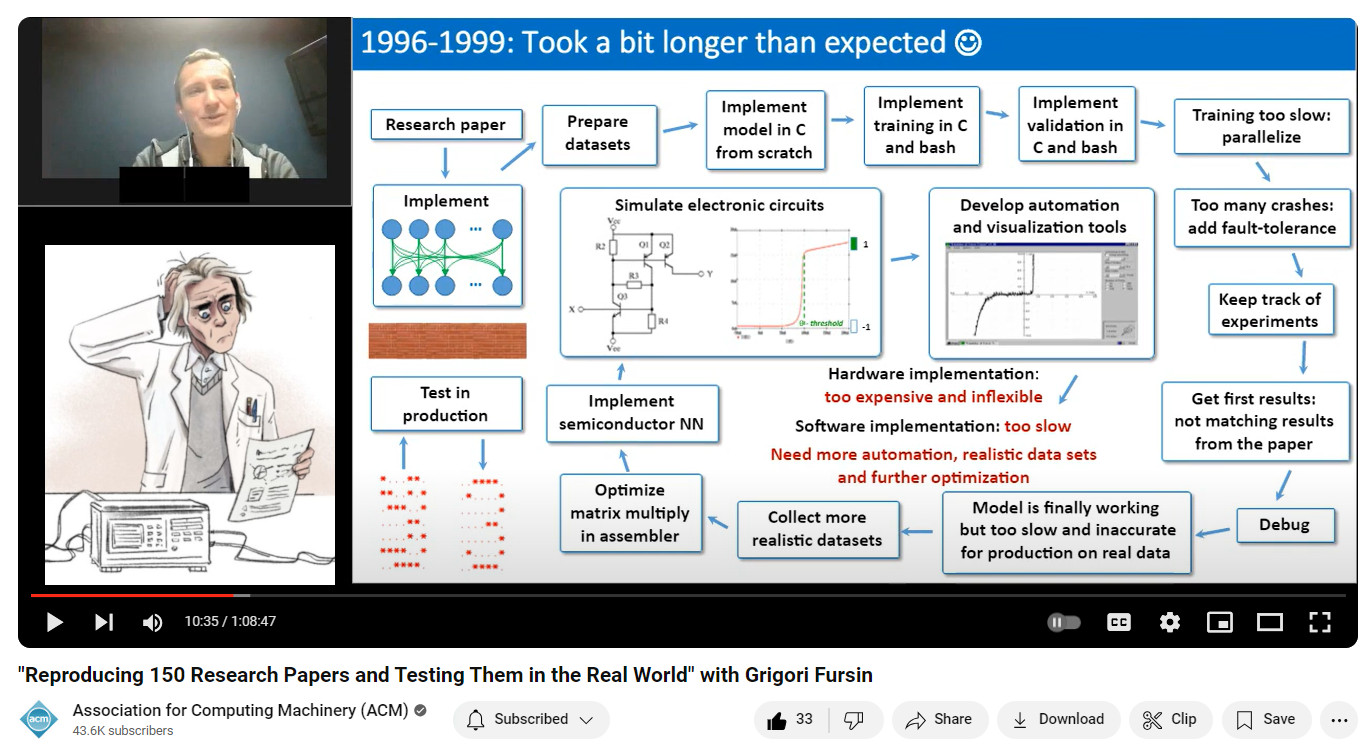
- Physical intelligent systems: in the 1990s, I co-designed a Hopfield-based analog semiconductor neural network from scratch, including models, training, datasets, software, circuit simulation, hardware, and low-level optimization.
- Systems that learn to optimize themselves: during my PhD in self-optimizing compilers and systems at the University of Edinburgh and subsequent research at Inria, I pioneered machine-learning-based self-optimizing compilers, collective tuning, and adaptive software–hardware co-design, including MILEPOST GCC and cTuning.
- Evidence that can be trusted and reused: when research results proved difficult to reproduce and transfer, I developed Collective Knowledge and Collective Mind, helped establish artifact evaluation and reproducibility practices, and built reusable automation for experiments and benchmarks.
- From research to production: I carried these ideas into open-source communities, commercial engineering, startups, MLCommons, MLPerf, acquired technology, AI infrastructure labs, and collaborations with software, hardware, cloud, automotive, and emerging-compute companies.
The technologies and organizations changed, but the underlying question did not: how can we make a complex computing system understand its own behaviour, learn from experience, and find better ways to meet real objectives and constraints?
Selected evidence and impact
- Two ACM/IEEE Test of Time Awards (2017 and 2025) for long-term impact in machine-learning-based compiler and systems optimization.
- Creator of Collective Knowledge, Collective Mind, Common Meta Framework (cMeta/cX), and reusable MLPerf automations for portable and reproducible experimentation, benchmarking, and optimization.
- Automations that helped the community produce more than 10,000 reproducible MLPerf results across diverse cloud-to-edge hardware and software stacks, together with the Open MLPerf Dataset and FlexBoard for collaborative analysis and predictive modelling.
- Author of the unified Artifact Appendix and reproducibility checklist adopted and extended by major ACM and IEEE conferences; helped reproduce results from more than 150 research papers.
- Founder and architect of the Collective Knowledge / cKnowledge.io platform acquired by OctoAI; later Vice President of MLOps at OctoAI, which was subsequently acquired by NVIDIA.
- Founding Member of MLCommons through the cTuning Foundation; former Head of AI Systems R&D at FlexAI, Co-Director of the Intel Exascale Lab, and tenured Research Scientist at Inria.
- More than 100 publications and invited talks, together with R&D and technology-transfer collaborations involving Arm, General Motors, Google, Amazon, Qualcomm, Intel, IBM, Lumai, and others.
How I contribute
I am most useful when a problem is important, technically deep, cross-disciplinary, and still poorly structured. I contribute in several connected ways:
- Companies and executive teams define research and systems strategy, establish and lead focused R&D labs and multidisciplinary teams, connect research with engineering and business outcomes, and avoid expensive technical or organizational dead ends.
- Startups and technology providers validate claims, benchmark and optimize new software and hardware across performance, cost, energy, and scalability, understand integration barriers, and shorten the path from a promising prototype to useful production deployment.
- Investors and partners evaluate deep-tech opportunities through technical due diligence, hands-on prototyping, reproducible experiments, and first-principles analysis of performance, cost, energy, scalability, and risk.
- Universities, foundations, industry consortia, open-source communities, and policymakers build reproducible collaborations and shared experimental infrastructure, connect researchers, engineers, and organizations, create practical educational programs, and form clearer bridges between emerging technology and societal or economic needs.
Across these settings, I enjoy building technologies and interdisciplinary teams, mentoring researchers, engineers, and entrepreneurs, and connecting communities around ambitious problems.
My longer-term ambition is to make this work scale beyond one-off advice: to encode methods, evidence, and experience in open and private platforms that help more people evaluate changing technology, accelerate scientific and engineering progress, and make better decisions in the real world.
Beyond research
Outside work, I enjoy spending time with my two children, playing football (after competing semi-professionally), designing unconventional—and sometimes crazy—interiors, hands-on DIY, reading and philosophy, hiking and travelling, and thinking about how the systems, organizations, communities, and societies around me can work better.
Football has also shaped how I work: individual ability matters, but difficult problems are solved better when people share information, coordinate, and adapt as a team. That idea runs through my work on collective tuning, continuous collaborative benchmarking, reproducibility, and shared experimental knowledge.